Are You Truly a Hardcore Latex Fetishist? An Honest Self-Assessment Guide
One thing is certain: hardcore latex fetishism is absolutely real — and far more common than you’d ever expect. If you find yourself inexplicably drawn to latex, to the point where even a single glance is enough to set your mind racing, then don’t second-guess yourself. Chances are, you’ve already been a true hardcore latex fetishist for longer than you realize.
Table of Contents
What Is Latex?
(Freshly produced black natural latex fabric)
Latex comes in two forms: natural and synthetic. At Latexlook, we work exclusively with high-quality natural latex — harvested and processed directly from rubber trees — which can be crafted into an incredibly thin yet remarkably elastic film. This film is the foundation behind everything we make, from latex catsuits and latex dresses to latex hoods and beyond.
Unlike ordinary rubber, fashion-grade latex typically ranges from 0.25mm to 1.0mm in thickness. That’s thin enough to hug every curve of your body like a second skin, while still delivering that signature high-gloss shine and satisfying elastic snap that latex lovers know and crave. These qualities together are what make latex garments such a uniquely visceral sensory experience.
Why Does Latex Arouse Sexual Desire?
There’s no single definitive answer, but psychology and sexology research have offered some well-documented explanations worth exploring.
According to British sexologist Anil Aggrawal’s fetish classification study (published in the Journal of Forensic and Legal Medicine, 2009), material fetishism ranks among the most common fetish types — with rubber and latex sitting near the very top of the list. A separate survey cited by Dr. Justin Lehmiller in his book Tell Me What You Want (2018, Grand Central Publishing) found that roughly 18% of respondents had experienced sexual fantasies involving specific materials or garments, with latex and leather being the two most frequently mentioned.
Tell Me What You Want (2018, Grand Central Publishing)
So what exactly makes latex so erotic? The appeal tends to work on several levels at once:
The Second Skin Effect: The way a latex catsuit conforms to the body doesn’t just look incredible — it makes the wearer acutely aware of every inch of their own physique in a way that few other materials can replicate.
Power and Control: That feeling of being wrapped, compressed, and enclosed maps naturally onto the dynamics of dominance and submission that run through BDSM culture.
Taboo and Subcultural Identity: Latex has always existed on the fringes of mainstream fashion. Part of its pull is precisely that edge of the forbidden — wearing it feels like a statement, a kind of initiation into something most people will never understand.
How to Tell If You're a Hardcore Latex Fetishist?
Hardcore fetishist‘ isn’t a negative label — it simply describes a level of intensity. It means latex occupies a central place in your erotic psychology or sensory experience, rather than being just a passing curiosity. Here are three dimensions to help you find out where you stand.
Touch
Do you…
Feel a distinct sense of calm or excitement the moment you slip into a latex catsuit or latex dress?
Find yourself absentmindedly running your fingers across latex, and realizing you just can’t stop?
Have a strong physical reaction to the pressure of latex against your skin — not just the way it looks, but the way it actually feels?
Sight
Do you…
Notice an immediate physical response — a racing heart, a rush — when you see someone wearing a latex hood or latex dress?
Catch yourself stopping to stare whenever you come across latex clothing in a completely non-sexual context, like while shopping or scrolling through social media?
Feel something closer to obsession than admiration when you see that signature high-gloss shine that only latex produces?
Smell
This one often gets overlooked, but for many hardcore latex enthusiasts it’s just as important as anything else.Natural latex has a distinctive scent — a raw, faintly sulfurous rubber smell that’s unlike anything else.
Do you…
Take a slow, deliberate breath when you open a latex package, and find yourself genuinely savoring it?
Notice that the smell alone is enough to shift your headspace, even before you’ve put anything on?
If even one of these resonates with you across any of the three dimensions, that’s already a clear sign of strong hardcore latex fetishist tendencies. And if several of them hit close to home? That’s completely normal too — it likely means you’re what the community would call a multi-sensory latex fetishist, someone for whom the attraction runs deeper and wider than most.
Is hardcore latex fetishism a mental illness?
The answer is definitively no. The American Psychological Association (APA) draws a clear distinction in the Diagnostic and Statistical Manual of Mental Disorders, Fifth Edition (DSM-5) between ‘fetishism’ and ‘fetishistic disorder.’ Having a strong attraction to latex is, at its core, a paraphilia — a variation in sexual interest — not a pathology. It only becomes classified as a disorder when it causes significant personal distress or harm to others.
From a cognitive psychology perspective, latex fetishism typically develops through early sensory experiences or memories — a mechanism psychologists refer to as sexual conditioning. Researcher Michael Seto noted in his review of fetishism that most fetishes can be traced back to incidental associations formed around the time of puberty (Archives of Sexual Behavior, 2017).
Accepting your fetish is part of knowing yourself in a healthy way. Within fetishist communities, it’s often the shame — not the fetish itself — that does the real psychological damage.
Buying, Wearing, and Caring for Latex Properly
Buying
Stick with reputable brands and prioritize manufacturers who use natural latex — and before you buy anything, make sure you’re not allergic to it.
Pay attention to thickness. If you’re just starting out, 0.4mm is a good place to begin.
For latex hoods, go for a zip-up style first — they’re much easier to get on and off, and a great way for beginners to ease into the full-coverage experience.
A latex dress is the ideal entry point for everyday latex wear, striking a balance between visual impact and practical wearability
Latex requires lubrication. Use a silicone-based lubricant or a dedicated latex dressing aid — never anything oil-based, as it will break down the material over time.
When putting on a latex catsuit, start from the feet and slowly work your way up. Be mindful of your fingernails throughout the process.
Keep your first session to under an hour. Give your skin time to gradually adjust to that sealed, second-skin sensation.
Care
Hand wash with lukewarm water and a mild detergent after use. Keep it away from the washing machine.
Once it’s fully dry, apply a thin layer of latex shiner to protect the surface from oxidation and prevent discoloration.
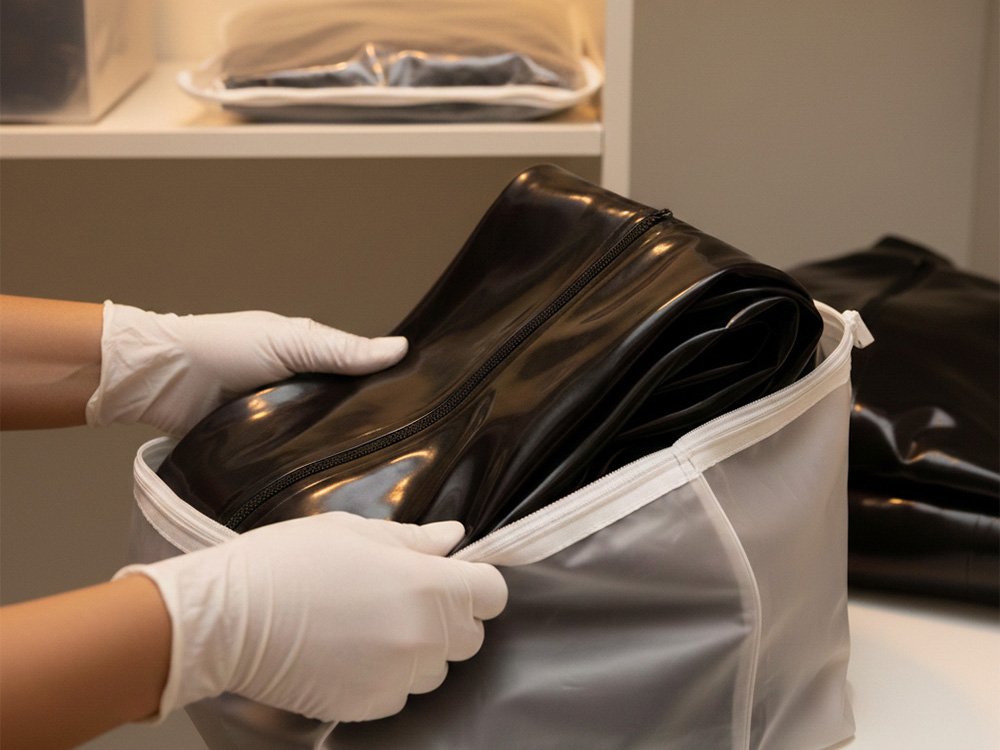
Store your pieces away from direct light, heat, and metal. Laying flat or hanging both work fine — just never fold them under pressure.
Closing Thoughts
If you’ve read this far and found yourself resonating with most of what’s described — then yes, you are very likely a genuine latex fetishist. And there is absolutely nothing wrong with that.Fetishism is part of the rich spectrum of human sexuality. Latex culture has a vibrant community, a sophisticated aesthetic, and its own distinct language. Whether you’re just beginning to explore your curiosity or you’ve been on this path for years, what matters most is this: be authentically yourself — with informed consent, safety, and awareness as your foundation.
Data Sources:
Medicine, 16(2), 73-78.
Lehmiller, J. J. (2018). Tell Me What You Want. Grand Central Publishing.
American Psychiatric Association. (2013). DSM-5: Diagnostic and Statistical Manual of Mental Disorders (5th ed.).Aggrawal, A. (2009). A new classification of zoophilia. Journal of Forensic and Legal
Seto, M. C. (2017). The puzzle of male chronophilias. Archives of Sexual Behavior, 46(1), 3-22.
FAQ About Hardcore Latex Fetishism
Just how common is hardcore latex fetishism?
Honestly, probably a lot more common than any statistic will ever show. Shame keeps most people quiet about it — plenty of hardcore latex fetishists will take that interest to their grave rather than breathe a word to anyone. Which means the real numbers are almost certainly way higher than whatever surveys and studies are able to capture.
Will I face discrimination for being a hardcore latex fetishist?
Unfortunately, yeah — people who don’t get it can be pretty quick to judge or mock. But here’s the thing: why give those people any real estate in your head? You’re not hurting anyone. You know what you like, you’re being true to yourself, and there’s absolutely nothing wrong with that. The people worth keeping around are the ones who respect that.
How do I bring up my latex fetish with my partner?
Honestly the most important thing is just creating a relaxed, low-pressure moment to talk about it — don’t make it feel like a big confession. Ease into it, be open about how you feel, and genuinely invite their thoughts without any pressure. The worst thing you can do is push or rush it. Give them space to process, and let the conversation go at its own pace. Forcing the issue almost always backfires.
As a beginner, how do I make latex garments easier to maintain?
Storage and care is genuinely the steepest part of the learning curve when you’re starting out — one wrong move and you’ve either damaged the piece or seriously cut its lifespan short. One option worth looking into is chlorination, which can make day-to-day maintenance a whole lot easier. That said, it’s not without its trade-offs, so it’s worth doing your homework before going that route — check out our chlorination page for the full breakdown.